
 Catherine Louise Turner
East Side Story News presents a guide to local supernatural folklore across the historic villages of East Leeds for Halloween. The feature explores regional legends, including the “Cliff Lady” of Barwick and Aberford, spectral figures near the Parlington Hall and Temple Newsam estates, the Wetherby Witches, and unsolved mysteries in Thorner and Scholes.
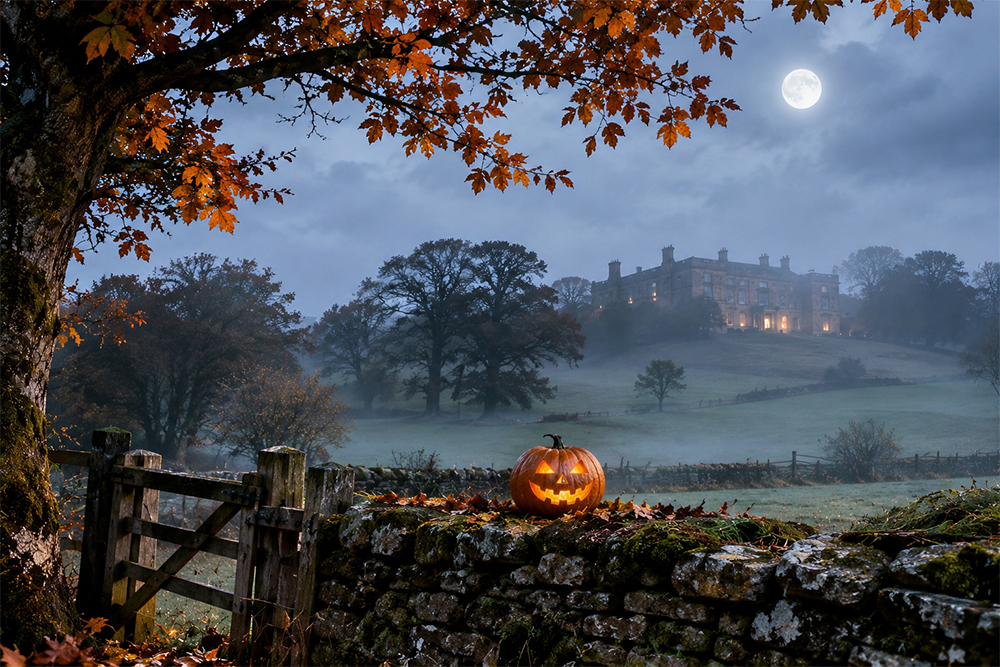
As the autumn fog rolls across the ancient, blood-soaked kingdom of Elmet and settles over the fields of East Leeds, our quiet commuter villages take on a distinctly eerie, suffocating atmosphere. While the bustling city centre looks to commercial, neon-lit scares this Halloween, the true local chills lie tucked away in the pitch-black corners of our rural hamlets. From phantom carriages to cursed highway routes, East Side Story News presents the definitive guide to the supernatural secrets hiding right on your doorstep. Step lightly—you are never truly alone.
The Cliff Lady of Barwick and Aberford
The twisting country roads linking Barwick in Elmet and Aberford are picturesque by day, but local folklore warns against traversing them after dark. For generations, terrified travellers have reported encounters with the “Cliff Lady”—a crepuscular, malevolent spirit said to haunt the high ground just above the black waters of the Cock Beck by the old Ass Bridge.
According to historical lore compiled from the Parlington estate records, she is believed to be the restless soul of a woman brutally murdered centuries ago. One chilling historical account describes a belated traveller watching a silent, horse-less carriage emerges from the midnight woods and glide across the road. Peering through the carriage window, the witness saw the pale, lifeless face of the Cliff Lady staring back with hollow eyes. Others claim to have seen her shimmering moonlight apparition, hunched over and frantically washing her blood-stained dress directly in the rushing waters of the beck.
The Ruins of Parlington and Garforth’s Spectral Intruder
Just a stone’s throw away lies Garforth, a town bordered by the skeletal remnants of the grand Parlington Hall estate. Though the main house was largely demolished, its dark, stagnant energy remains trapped in the soil.
In one post-war account, two local schoolboys snuck past the gamekeepers to explore the vanishing ruins. Climbing a grand, sweeping staircase that led to nowhere, they suddenly came face-to-face with a silent, featureless figure who vanished into thin air before they could scream. Decades later, another group of children exploring the drawing-room footprint encountered a towering man dressed in an antique cloak and a broad-brimmed hat, standing perfectly still where the floorboards used to be, suspended over the drop. To this day, walkers heading out on the old Roman roads from Garforth toward Towton report an oppressive, heavy air that leaves even the bravest dogs whimpering and refusing to advance.
The Wetherby Witches and the Marston Moor Militia
Heading further north up the A1 corridor, the historic market town of Wetherby boasts a ghostly population as diverse as it is terrifying. The epicentre of the town’s hauntings is the Swan and Talbot, an ancient coaching inn that has welcomed travellers for over 400 years.
Wetherby’s most notorious supernatural residents are the Walker sisters—Aggie, Emma, and Sage. Better known as the “Wetherby Witches,” the three sisters were expelled from St James’s Church under accusations of witchcraft and heresy. Local legend insists they met a gruesome end, and their restless spirits still roam the nearby cobbled streets. Inside the pub itself, the first floor is famously haunted by two boy urchins – tragic inmates from the old Wetherby Workhouse who died in agony while being forced to work at the inn.
If you are driving on the outskirts of Wetherby late at night, keep your eyes firmly on the road. Multiple motorists have reported the deeply unsettling sight of Civil War soldiers dressed in full, tattered Royalist uniform—remnants of the bloody retreat from Marston Moor in 1644—standing silently at modern-day bus stops, waiting for a transport that will never arrive.
Unsolved Shadows in Thorner and Scholes
The quiet, tightly knit communities of Thorner and Scholes are bound together by dark historical mysteries. The scenic walking trails of the Leeds Country Way that cut between Barwick, Scholes, and Thorner are home to sudden, inexplicable drops in temperature and the distinct sound of invisible footsteps crunching through the autumn leaves closely behind you.
In Thorner, the shadow of a real-world tragedy still lingers. Locals visiting St Peter’s Churchyard after dusk speak of a heavy, sorrowful energy. It is closely tied to the infamous, unsolved 1948 murder of a young local woman on nearby Ling Lane—a cold case that has baffled police for generations. Paranormal enthusiasts whisper that a female figure in mid-century clothing has been spotted gliding along the rural verges between Scholes and Thorner, her face obscured, disappearing into the hedgerows the exact moment a car’s headlights catch her.
THE BLOOD ON THE COLOURED STEPS: Forgotten Terrors of Temple Newsam
If the dark lanes of Elmet hold the spirits of the open road, it is the sprawling, majestic estate of Temple Newsam that acts as a stone vault for East Leeds’ most concentrated horrors. Dubbed by historians as the “Hampton Court Palace of the North,” this 500-year-old Tudor-Jacobean mansion sits just on the fringe of our eastern suburbs. By day, families walk its manicured gardens; by night, the oppressive weight of half a millennium of betrayal, madness, and murder settles into the brickwork. East Side Story News steps past the grand threshold to reveal the entities that refuse to leave the estate.
The Mania of the Blue Lady
The most infamous resident of the grand house is the tragic spirit of Lady Mary Ingram, known to terrified late-night staff as the “Blue Lady.” Daughter of the wealthy Ingram dynasty that ruled the estate for centuries, Mary’s torment began on a pitch-black night in the late 17th Century.
While returning to the estate by carriage from a party, her transport was violently ambushed by a ruthless gang of highwaymen near Garforth. The thieves stripped her of all her belongings, violently tearing away her most prized possession—a heavy pearl necklace given to her as a christening gift. Mary escaped on foot, but the psychological trauma cracked her mind. She awoke the next day with no memory of the robbery, consumed by a manic obsession that she had simply misplaced her pearls.
Mary spent her remaining short days in a state of frantic psychosis, clawing open furniture cushions and ripping up floorboards to find her lost jewels, eventually starving herself to death at just fourteen years old. Today, her apparition drifts through the grand Gothic Room. Visitors report a sudden, bone-chilling drop in temperature, followed by the faint, agonizing sound of fingernails scratching frantically against the wooden walls.
The Screams on the Back Stairs
Deep within the older, darker corridors of the house lies a malice born of cold-blooded murder. In 1704, a young nursemaid named Phoebe Gray was working late into the night when she was cornered on the narrow back servants’ stairs by another estate worker, William Collinson. For reasons lost to history, Collinson brutally suffocated the young girl, hiding her lifeless body in the dark, cavernous cellars beneath the house.
Collinson was eventually caught and hanged for his crime, but Phoebe’s final moments of terror remain permanently looped in time. To this day, the back staircase is a zone of profound dread. Ghost hunters and evening security guards have recorded heavy, desperate thumps tumbling down the stairs, accompanied by a muffled, choking scream that echoes up from the locked cellar doors.
The Midnight Rider of the Library
While many spirits at Temple Newsam evoke pity, the presence in the Georgian Library inspires pure, primal fear. In the late 19th Century, Hugo Meynell Ingram – the final male heir to the estate—suffered a catastrophic riding accident while out on a hunt, dying from his injuries at age 50. His grieving widow later converted the estate library into a private chapel in his memory.
The chapel is gone, but Hugo is not. Since the 1960s, a solid, towering apparition dressed in full, period-accurate riding clothes and a sweeping black cape has been seen standing silently among the bookshelves. Unlike the drifting, ethereal presence of the Blue Lady, the Midnight Rider is described as terrifyingly physical. Those who have locked eyes with him report a gaze of intense, aristocratic fury, followed by the sudden, violent slamming of heavy library doors by completely invisible hands.
As you look up at the illuminated windows of Temple Newsam from the motorway this October, remember that behind those beautiful, historic walls, a centuries-old search for lost pearls and the echoes of a nursemaid’s final breath—are still playing out in the dark.
This Halloween, if you visit the grand estates, walk the historic streets of Barwick or drive the dark lanes of Elmet, remember that our local history isn’t just trapped in the archives. Sometimes, it walks right beside you.
Support independent community journalism!
East Side Story covers the people, places and stories in Leeds that are too often overlooked. While national headlines chase conflict and clickbait, we focus on real communities and the issues shaping daily life in East Leeds.
Divisive content, AI noise and online rumours spread faster than ever. At the same time, many mainstream outlets are stretched and rarely spotlight the community organisations and local champions who deserve recognition.
East Side Story was created to change that. We answer only to our readers. We have no corporate owners or billionaire funders. Our journalists report freely, ask difficult questions and hold power to account.
Your support helps us keep this work going. Monthly contributions make the biggest impact because they allow us to invest in deeper reporting and fearless local journalism.
Supporters also receive exclusive updates, behind the scenes insights and other benefits as a thank you for keeping independent journalism alive.